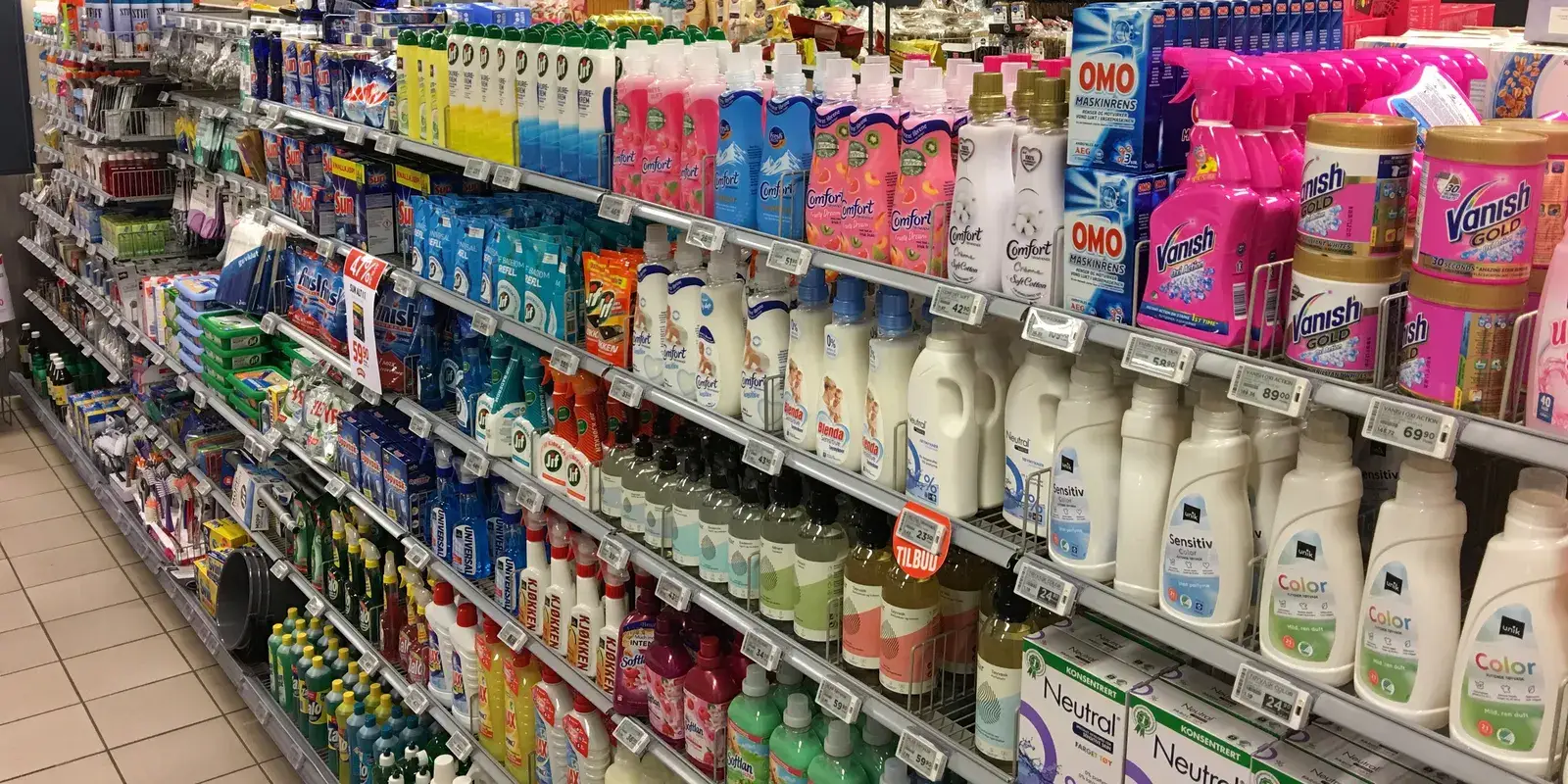
Refill formats look like a margin story and they are really a space story. A concentrate tablet does the same job as a gallon of ready-to-use liquid while occupying about a fortieth of the shelf — which is either the best thing that ever happened to a four-foot cleaning section, or a very expensive way to confuse your customers.
Both outcomes are common. The difference between them is almost entirely about how the section is set, not about which brand you picked.
Revenue per linear foot, not margin per unit
Independents tend to evaluate a new line on margin percentage. For a small cleaning section that is the wrong measure, because the constraint is not capital, it is the four feet of shelf. What you want to compare is revenue per linear foot per week.
Work it with round numbers. Assume a standard 4 ft shelf, 48 inches of facing.
- Gallon jug, ready to use. Roughly 6 in wide, so 8 facings across a shelf. Sells at $14.99. If each facing turns 0.5 units a week, that is 4 units × $14.99 = $59.96 per shelf per week.
- 25 oz trigger spray. Roughly 3.2 in wide, 15 facings. At $9.99 and 0.7 turns per facing per week: 10.5 units = $104.90.
- Tablet refill, 3 ct box. Roughly 2.4 in wide, 20 facings. At $11.99 and 0.6 turns: 12 units = $143.88.
The tablet box wins on a metric the gallon can never win on, and it wins without a higher retail price. This is the actual argument for refills in a small store — not sustainability, not margin, but that they let a 4 ft section behave like a 6 ft one.
The number that ruins it
All three lines above assume the units turn. Tablets frequently do not, at first, and the reason is boringly practical: a customer who has never bought one does not know what it does. A gallon of all-purpose cleaner explains itself from six feet away. A 2.4-inch box containing three white discs does not.
In practice a refill SKU takes six to ten weeks to reach steady-state movement in a store that has not carried the format before, and it will underperform every projection during that window. If you judge it at week four you will pull it just before it starts working.
Setting the section so the format explains itself
The single highest-return merchandising decision in this category is placing the starter bottle and the refill adjacently, at the same eye level, with the starter to the left. Left-to-right matches how most shoppers scan a shelf in North America, and it puts the object that explains the system before the object that needs explaining.
Three things that consistently move the needle:
- Sell the starter kit as the anchor, not the refill. A glass bottle plus one tablet at $16.99 converts a first-time buyer. A three-tablet refill at $11.99 converts nobody who does not already own the bottle.
- Put the dilution on the shelf tag, not just the box. "1 tablet + 16 oz water = 1 spray bottle" on a tag does more work than any packaging claim, because it is read at decision distance.
- Do not split the system across the section. If bottles are on the top shelf and refills are at knee height with the value packs, the repeat purchase does not happen — and the repeat purchase is the entire economics of the format.
The reorder profile is different too
Ready-to-use liquids have a smooth, predictable draw. Refill systems have a two-stage one: an initial burst of starter kits, then a quiet six to eight weeks, then refills beginning to repeat as the first cohort runs out. If you reorder on a simple four-week look-back you will over-buy starters in month two and be out of refills in month three.
The correction is simple. Track starter and refill units separately, and treat starter sales in a given month as the forecast for refill demand roughly two months later. In our own account data the ratio settles at about 2.4 refills per starter per year, which is a useful planning figure for a first section.
What this means for the buy
A first refill order for a 4 ft section that is currently all ready-to-use looks something like this: two facings of starter kits, four of refills, and leave the rest of the section alone. Cannibalizing the whole shelf for a format the store has never sold is how a good category becomes a markdown.
Our refill and concentrate block runs 246 SKUs across 5 brands in gallon, tablet and pod formats, and the pricelist gives the bulk-to-retail unit math per line so you can run the comparison above without doing the conversions yourself.
Where refills genuinely do not work
Two situations, both worth naming plainly.
The first is a store where staff cannot spend thirty seconds with a customer. Refill systems sell through explanation, and if the counter is one person during a rush, that explanation does not happen and the section underperforms regardless of how it is set.
The second is a very price-sensitive trade area. Refills are cheaper per use and more expensive per transaction — $16.99 for a starter kit is a real barrier where a $4.99 spray is the reference price. The format works up-market and in refill-oriented stores; it struggles where the basket is small and price is the whole decision.
Neither of these is a reason to skip the category. They are reasons to size the first order at two facings instead of twelve.
Key takeaways
- Judge a refill line on revenue per linear foot per week, not margin percentage — shelf space is the binding constraint in a 4 ft section.
- A 3 ct tablet box can generate roughly 2.4× the weekly revenue per shelf of a gallon jug at a similar retail price.
- Refill SKUs take six to ten weeks to reach steady movement in a store new to the format. Do not judge them at week four.
- Set starter left, refill right, same eye level, dilution ratio on the shelf tag. Splitting the system across the section kills the repeat purchase.
- Plan on roughly 2.4 refills per starter per year, and forecast refill demand from starter sales two months earlier.